
Metrics don't just measure encoder performance; decoding matters too, and even after decoding, not all post-processing is created equal.
In developing our proprietary encoder Iris for WebP, our aim with public and private testing is to properly demonstrate the value of the encoder compared to alternatives. Cheating benchmarks, overfitting for metrics, or unfairly testing other encoders does not help sell our product, which is meant to provide quality-of-experience improvements for human users above all else.
Investigating WebP's decoding performance led us to begin evaluating different
means of presenting the decoded images to metrics. Even within the dwebp
reference decoder, there are a number of different options that affect how
images are decoded.
Beyond WebP, we test competing open-source encoders as well. These should be tested in such a way that they represent their best performance in real-world production scenarios, where client-side decoder options are still highly relevant.
Our findings here are not final, but this blog post aims to get the ball rolling for evaluating decoder differences and means for handling chroma in post-processing.
Chroma Subsampling
Chroma subsampling is a useful compression technique to improve compression efficiency at low to medium-high fidelity by taking advantage of the human visual system's higher sensitivity to luma-only detail. The YCbCr color space utilizes principles of opponent color theory and separates luma from chroma, so many encoder implementations still find value in using this colorspace to halve the resolution of the chroma planes (Cb, Cr) and concentrate bits into the luma plane (Y). This is the theoretical basis behind 4:2:0 chroma subsampling: 4 luma pixels for every 1 chroma pixel in each plane. At higher fidelity, maintaining full-resolution chroma planes is often more valuable, and thus 4:4:4 chroma subsampling (all planes at full-resolution) can be much better.
Arguably, one of WebP's most difficult limitations is mandatory 4:2:0 chroma subsampling. This limitation isn't present in JPEG or AVIF, which both support YCbCr in 4:4:4 alongside 4:2:0. There has been some very cool work by Pascal Massimino on this limitation in libwebp, but properly handling chroma subsampling is a codec-agnostic issue due to Web quality ranges often favoring 4:2:0. The better utilized the lower-resolution chroma planes are, the better the output images will be – this is true for both encoding and decoding.
Encoding
The aforementioned work by Pascal focuses on taking a full-color input and
optimally downsampling the chroma planes. This doesn't involve the WebP codec
whatsoever; it is true that dwebp's "fancy" chroma upsampling at decode time
may pair well with "Sharp YUV" encodes, but "Sharp YUV" is not a WebP encoder
feature – it is a preprocessing feature that libwebp supports, and may be used
by any encoder in theory. This is a matter of opinion, but we're not partial to
considering gains through "Sharp YUV" preprocessing as encoder efficiency, as
they may apply to any encoder for any format supporting 4:2:0 chroma
subsampling. Measuring pure encoder efficiency should be done by controlling the
color conversion process between encoders, as is done via
SVT-AV1's open-source benchmarking tools.
There's lots to discuss with regards to encoding here, but for the sake of this post we're going to focus primarily on decoding.
Decoding
Compression researcher Jon Sneyers once said that "The video codec philosophy has always been 'we just compress matrices of numbers, how to interpret them is not our problem'," which can be interpreted as a call for image compression researchers to do better. While it is true that pre- and post-processing are not coupled to encoder or decoder efficiency, they are still relevant to overall compression efficiency. With YCbCr 4:2:0 inputs, we must decide how to represent our one chroma sample per four luma samples via post-processing after decoding. So, what should we do with the decoder's matrices of numbers?
For this blog post, we're going to test a couple of different implementations with some open-source codecs. We'll invariably end up investigating some level of decoder performance here as well, particularly with JPEG.
Methodology
For encoders, we are testing Google's jpegli for JPEG, libwebp and Iris-WebP for WebP, and SVT-AV1 for AVIF. For jpegli, color conversion is done internally. For libwebp, we test default color conversion with FFmpeg, internal color conversion, and internal "Sharp YUV" color conversion. Color conversion is done with FFmpeg for SVT-AV1 and Iris, as the differences demonstrated by libwebp's results should get the point across. We have our own input chroma processing algorithm for Iris, but we don't think this is the right place to discuss its impact.
To convert the encoded outputs back to pixels, we are looking at FFmpeg,
jpegli's decoder, ImageMagick, dwebp from libwebp, and
dav1d. Note that WebP and AVIF
are both decoded by libwebp and dav1d respectively with every option here; what
wraps each decoder is what is different. Alongside default FFmpeg, we're testing
a custom filter for chroma:
"scale=flags=lanczos+accurate_rnd+full_chroma_int:param0=5,format=rgb24". This
string specifies we're using a sharp 5-tap Lanczos scaling algorithm with
mathematically accurate rounding and high-quality chroma interpolation, which
may result in higher fidelity outputs post-decode.
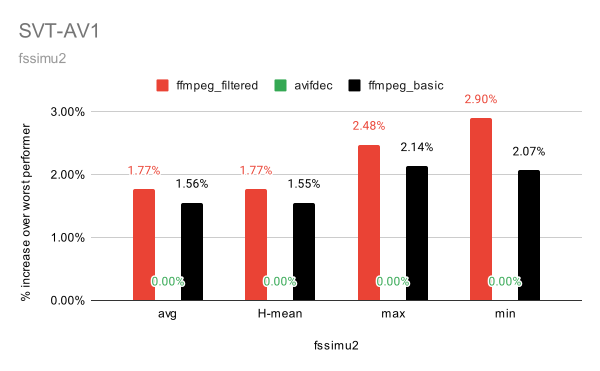
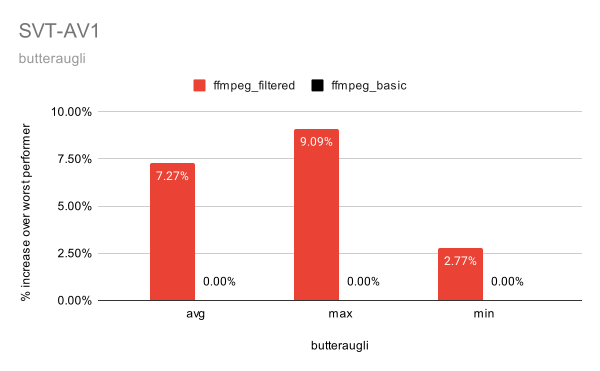
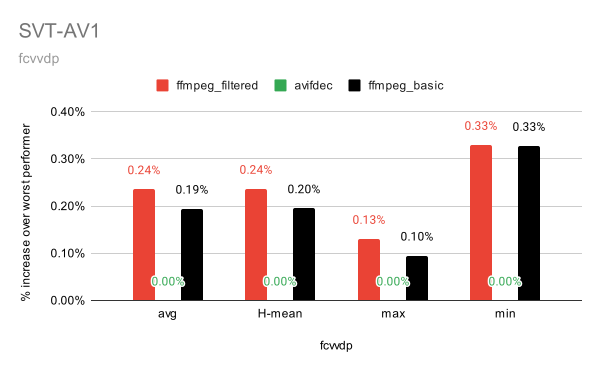
For metrics, we are looking at fssimu2, Butteraugli from libjxl at 3-pnorm and an intensity target of 203 nits, and our own fcvvdp with the default "fhd" display. These are all perceptual metrics aimed at producing results relevant to the human visual system.
Testing is done on the gb82 image set, a diverse photographic image dataset of 25 images all at 576x576. The script used for testing can be found in the open source decbench repo.
Results
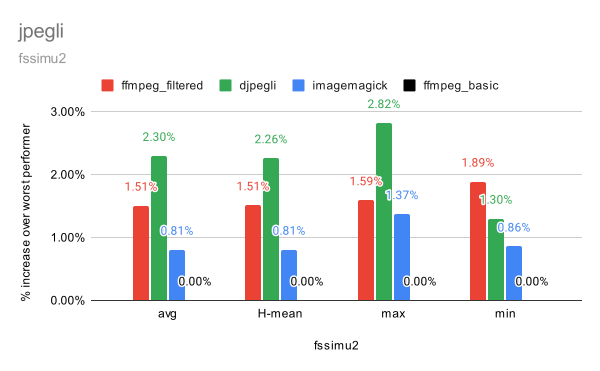
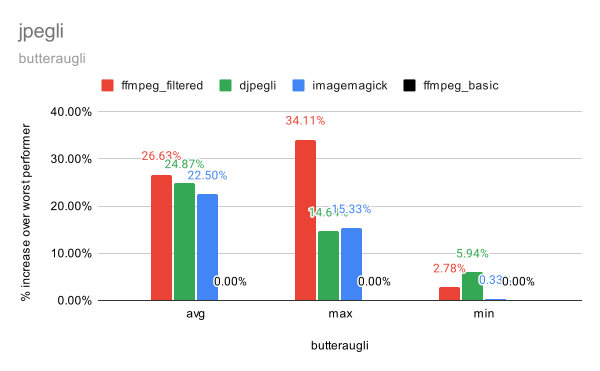
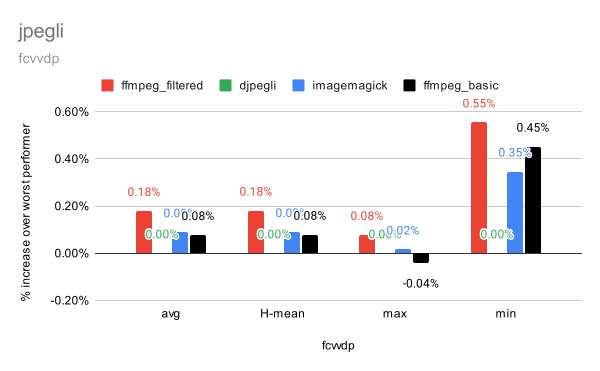
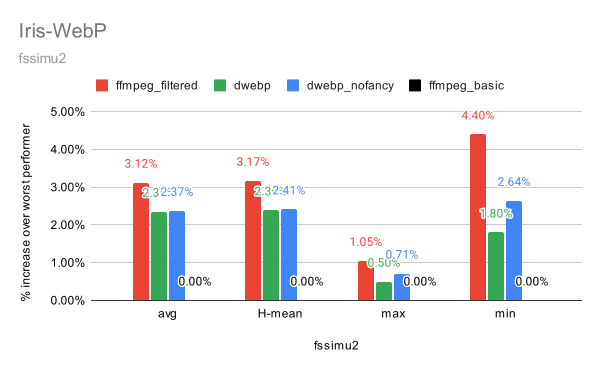
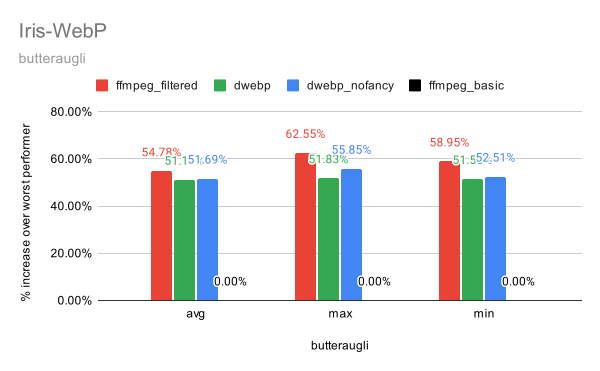
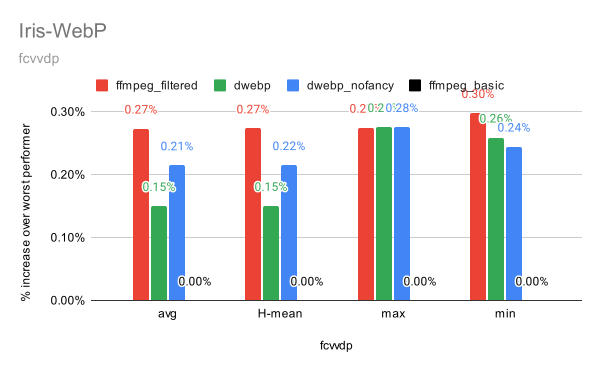
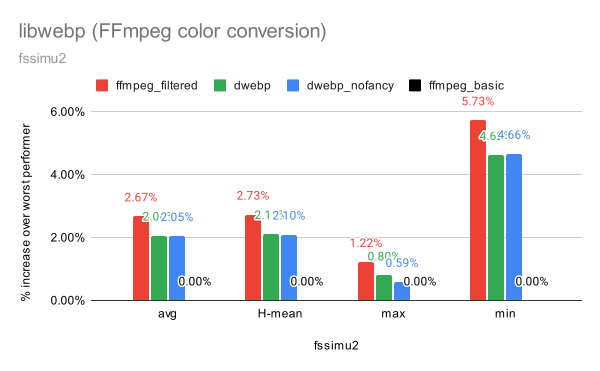
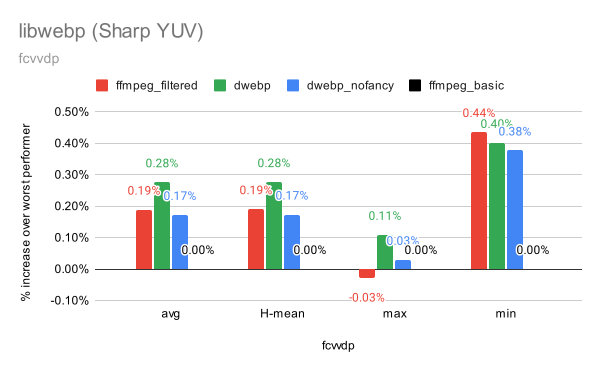
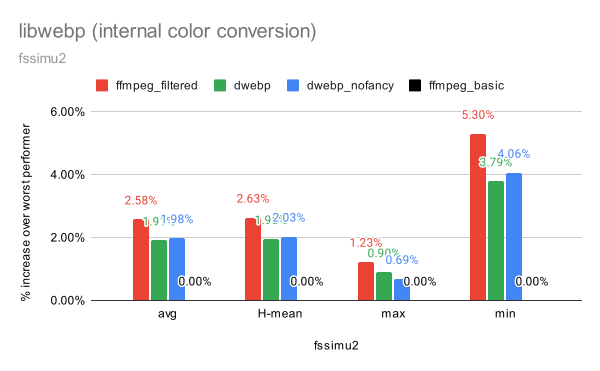
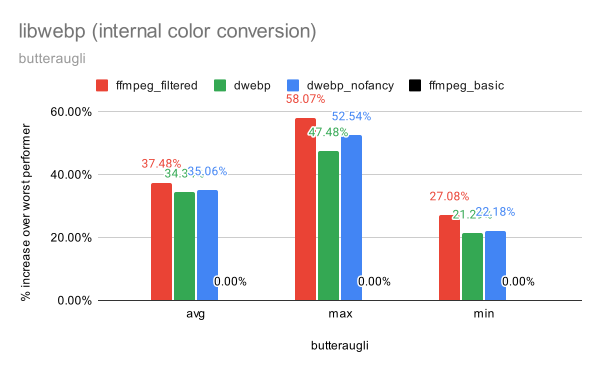
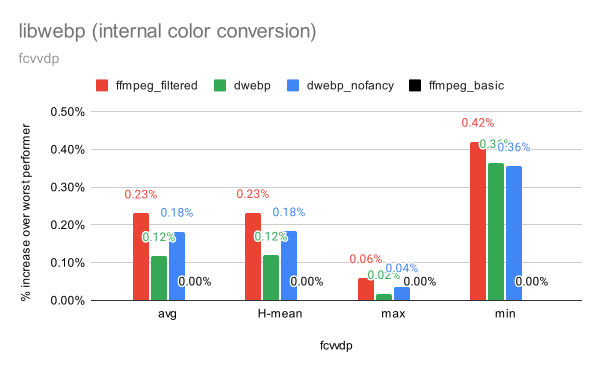
It is VERY important to note that this is not an encoder efficiency test, and that size & quality results between encoders are not controlled in any way. The only relevant results are from the decoder & post-processor implementations, which all come from the same inputs and therefore represent some kind of efficiency improvement if the scores are higher.
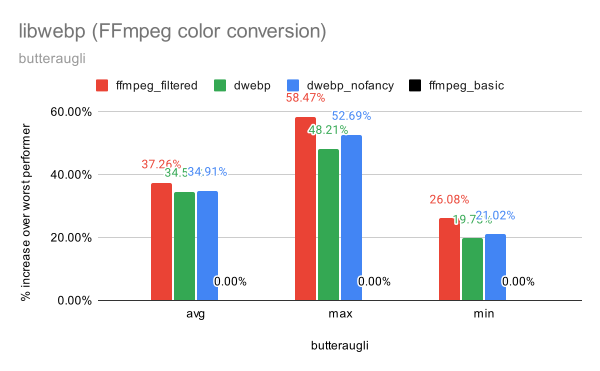
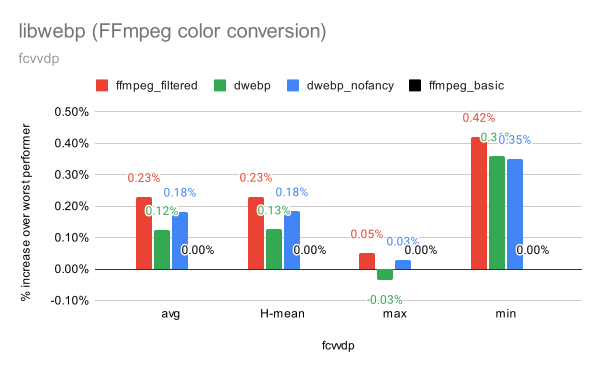
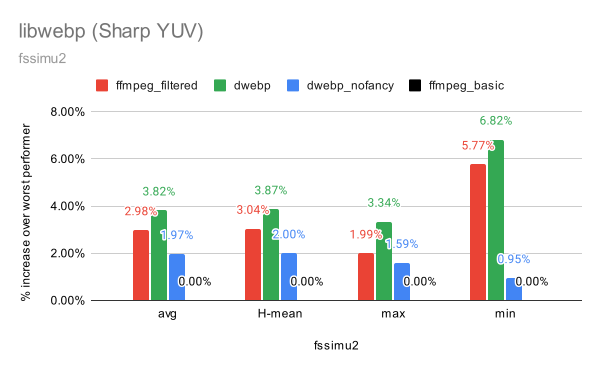
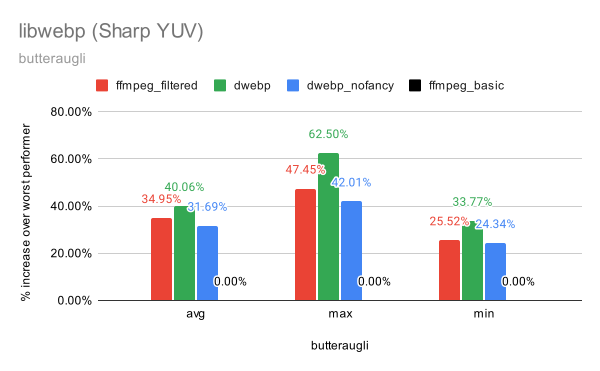
Please note that the harmonic mean is not super useful for Butteraugli; there
isn't much utility in biasing toward lower Butteraugli scores, as they are
better. dwebp_nofancy disables the libwebp decoder's internal "fancy" chroma
upsampling.
jpegli
./dec.py jpegli ~/Pictures/gb82-image-set/png/*.png
Iris-WebP (FFmpeg color conversion)
libwebp (FFmpeg color conversion)
./dec.py libwebp ~/Pictures/gb82-image-set/png/*.png
libwebp (Sharp YUV color conversion)
./dec.py libwebp_sharpyuv ~/Pictures/gb82-image-set/png/*.png
libwebp (internal color conversion)
./dec.py libwebp_default ~/Pictures/gb82-image-set/png/*.png
SVT-AV1
./dec.py svtav1 ~/Pictures/gb82-image-set/png/*.png
avifdec's PNG outputs crashed the butteraugli_main tool
Perceptual Results
Click the buttons to switch between decoding/post-processing options on this challenging image.
Conclusion
The Butteraugli results are shocking, and likely merit further investigation. Aside from that, the fact that a >2% fssimu2 efficiency improvement is achievable compared to the baseline in almost every test is valuable; compression researchers fight very hard for 2%, and we get it for free here.
ffmpeg_filtered shows very good results across the board. There is potentially
room for further investigation here through using other scaling algorithms.
The noteworthy outliers are djpegli winning according to fssimu2, and dwebp
winning when "Sharp YUV" color conversion was used with libwebp.
JPEG decoding is a complex topic we are not going to explore in detail here, but it boils down to the fact that the JPEG spec has a of ambiguity regarding the way images are encoded and decoded.
For libwebp, Pascal's page says: "We utilise the upsampling used at decoding
time (dubbed 'fancy upsampling' in libjpeg e.g.) to our advantage," with regards
to Sharp YUV. It may be the case that with minor tweaks, Sharp YUV may be made
to work better with other chroma scaling methods like we see in
ffmpeg_filtered. It also isn't conclusive that "fancy upsampling" as it is
implemented in libwebp's decoder is actually a net positive; with fancy
upsampling disabled, dwebp_nofancy ekes out some wins over dwebp when Sharp
YUV isn't used. Sharp YUV is also disabled by default in libwebp due to its
computational complexity (Pascal: "Sharp-YUV locally optimizes the conversion
loss, so is more expensive. That's why -sharp_yuv is not the default option in
cwebp!"), so should dwebp be best prepared for the most popular encode use
cases, or those that achieve the best performance? Sharp YUV isn't universally
perceptually beneficial either, so the problem becomes harder to solve with that
in mind.
For our research direction stated at the beginning of this post, we see
promising results that tell us using the default tooling for other codecs might
be holding them back. ffmpeg_filtered wins in many cases, so at least for
SVT-AV1 and jpegli, it seems like a valuable option to consider. A future
direction may be to explore the computational complexity of different decoders
and decode options, or to do more subjective testing and go beyond metrics.
There's always more to explore with multimedia compression, and we've only scratched the surface of pre- and post-processing for 4:2:0 YCbCr here. Halide Compression is built on frontier compression expertise, so if you believe we could be valuable to you, we offer consulting services. Feel free to contact us at our email below if you have any questions about decoder optimization for your pipeline, deploying WebP at scale, or using Iris-WebP to maximize the efficiency of your image delivery solution. Thanks for reading!